
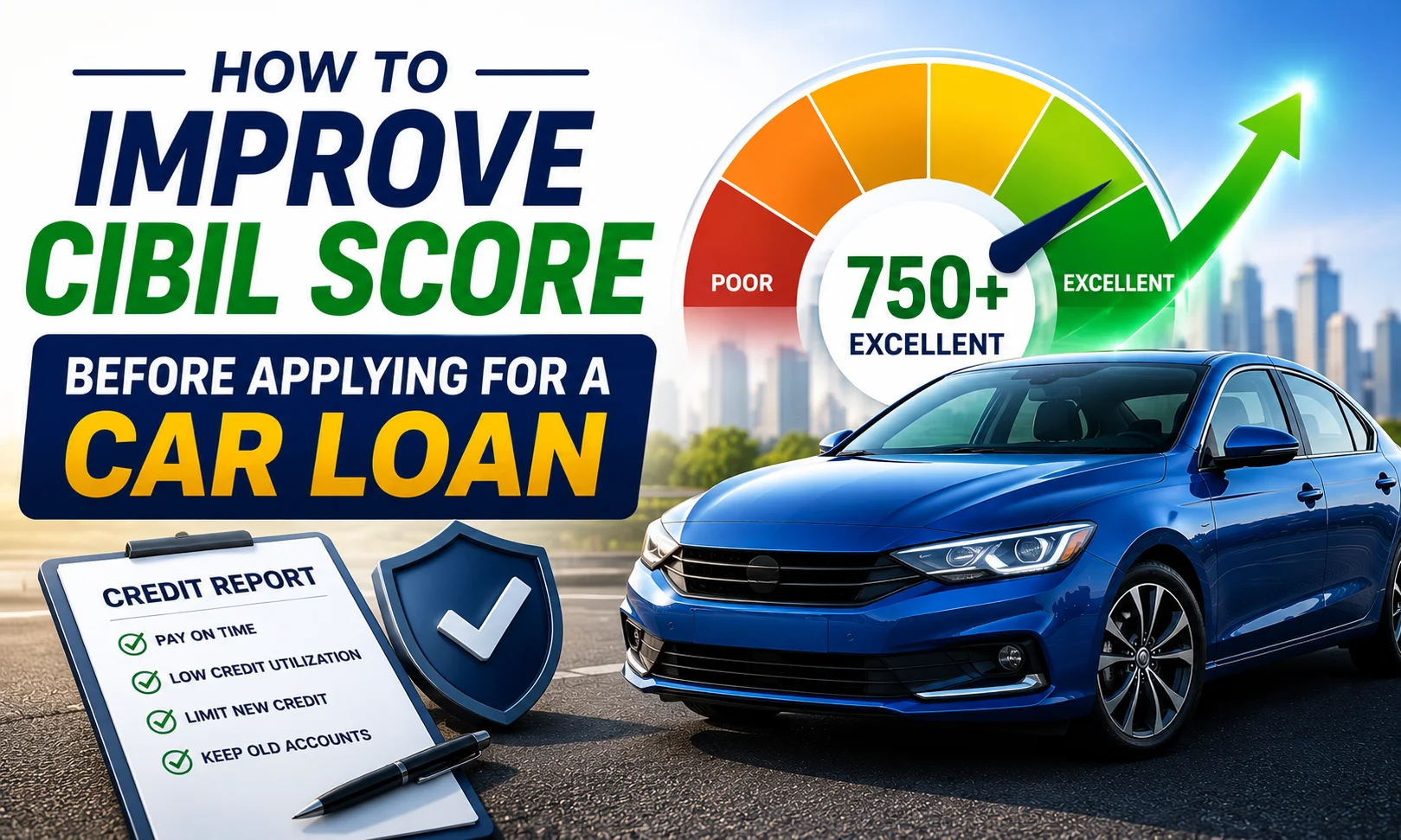
Planning to finance your next car? Your CIBIL score is one of the factors lenders may consider when evaluating your creditworthiness, so improving your credit profile before applying can strengthen your overall loan application.
A healthier credit profile can help you approach lenders with greater confidence, but your CIBIL score is not the only factor considered during car-loan assessment. Income, employment or business stability, existing EMIs, repayment capacity, loan amount, vehicle details, and lender policies can also influence the final decision.
How to Improve CIBIL Score?
To improve your CIBIL score before applying for a car loan, pay all EMIs and credit-card bills on time, reduce credit utilisation, clear overdue payments, check your credit report for errors, avoid unnecessary credit applications, manage existing debt responsibly, and maintain these habits consistently.
There is no guaranteed method to increase your CIBIL score by a specific number of points within a fixed period. The improvement you see depends on your existing credit history, outstanding debt, repayment behaviour, credit utilisation, reporting cycles, and the nature of any negative information on your report.
Can You Improve Your CIBIL Score Before a Car Loan?
Yes, you can take several steps to improve your credit profile before applying for a car loan, although the speed and extent of improvement will vary depending on your individual credit history and financial circumstances.
Start by reviewing your CIBIL report, identifying overdue accounts or reporting errors, paying outstanding dues, reducing high credit-card balances, and avoiding unnecessary new credit applications while preparing for your vehicle purchase.
If your credit profile contains recent late payments or significant defaults, improvement may require consistent responsible repayment over a longer period. Correcting inaccurate information or reducing high utilisation may produce changes sooner, but no fixed improvement timeline applies to every borrower.
Why Your CIBIL Score Matters When Applying for a Car Loan
Your CIBIL score provides lenders with an indication of your past credit behaviour and repayment history, making it an important part of the overall credit assessment process for many loan applications.
A stronger credit profile may make you a more attractive borrower, while a weaker profile can lead lenders to examine your application more carefully. However, lenders generally consider your complete financial profile rather than relying solely on your CIBIL score.
Your income, employment or business stability, existing financial obligations, requested loan amount, repayment capacity, down payment, vehicle details, documentation, and lender-specific policies can all influence the eventual lending decision.
What Is a Good CIBIL Score for a Car Loan?
CIBIL scores generally range from 300 to 900, with higher scores indicating stronger credit histories. A score around 750 or above is commonly viewed as a healthy credit profile, although there is no universal score that guarantees car-loan approval.
| CIBIL Score | General Credit Profile | Car Loan Consideration |
|---|---|---|
| 750–900 | Strong | Generally a healthier credit profile |
| 700–749 | Good | Eligibility depends on overall profile |
| 650–699 | Moderate | Lender criteria become more important |
| Below 650 | Weaker | Financing may require additional assessment |
These ranges should be treated as general guidance rather than universal lending rules because individual lenders can establish their own eligibility criteria, pricing policies, and credit-assessment methods.
If you want to understand the broader factors lenders consider before approving vehicle financing, read our detailed guide on car loan eligibility.
10 Ways to Improve Your CIBIL Score Before Applying for a Car Loan
Improving your CIBIL score is primarily about demonstrating responsible credit behaviour consistently rather than using a quick workaround that promises an immediate increase.
The following steps can help you build a stronger credit profile while also improving your overall financial readiness before submitting a car-loan application.
1. Pay Every EMI and Credit Card Bill on Time
Payment history is an important part of your credit profile, so consistently paying loan EMIs and credit-card dues by their respective due dates can help demonstrate responsible borrowing behaviour.
Even occasional delays can become problematic when they are reported to credit bureaus, particularly when missed payments remain unresolved. Set payment reminders or automatic payments where appropriate to reduce the possibility of accidentally missing a due date.
What You Should Do
- Pay EMIs before their due dates.
- Pay credit-card bills on time.
- Maintain sufficient balance for automatic payments.
- Track all active loan and credit-card due dates.
- Address missed payments as soon as possible.
If you already have multiple financial commitments, creating a monthly repayment calendar can make it easier to manage your obligations before taking on another loan.
2. Reduce Credit Card Utilisation
Credit utilisation refers to the proportion of your available revolving credit that you are currently using, and maintaining lower balances can contribute to a healthier credit profile.
For example, if your combined credit-card limit is ₹1,00,000 and your outstanding balance is ₹30,000, your utilisation is 30%. Lower utilisation is generally preferable to consistently using most of your available credit.
Simple Formula:
Credit Utilisation = Outstanding Credit Card Balance ÷ Total Credit Limit × 100
Avoid treating a particular percentage as a guaranteed CIBIL scoring formula because credit scoring considers multiple factors. Instead, focus on keeping balances manageable and avoiding consistently high utilisation.
3. Clear Overdue Payments
If you have overdue EMIs or credit-card payments, addressing them should be a priority before applying for another loan because unresolved overdue amounts can negatively affect your credit profile and repayment assessment.
Review each outstanding account carefully and determine the amount required to bring the account up to date. Keep payment confirmations and related records after clearing legitimate dues for your own financial documentation.
If an account has already been reported with negative information, paying the outstanding amount does not necessarily mean the historical information immediately disappears from your credit report.
4. Check Your CIBIL Report for Errors
Reviewing your credit report before applying for a car loan can help you identify inaccurate personal information, unknown accounts, incorrect outstanding amounts, duplicate accounts, incorrect payment records, or unfamiliar credit enquiries.
If you discover information that does not belong to you or appears inaccurate, raise a dispute through the appropriate credit-bureau process and retain the relevant supporting documentation.
Checking your own credit report is also useful because it allows you to understand your current credit position before a lender performs its own assessment during a formal loan application.
Check For:
- Incorrect personal details
- Unknown credit accounts
- Duplicate accounts
- Incorrect outstanding balances
- Incorrect payment history
- Incorrect account status
- Unrecognised credit enquiries
Do not assume that every negative entry is an error simply because it affects your score. Verify the information carefully before raising a dispute.
5. Avoid Multiple Loan Applications
Submitting several formal loan applications within a short period can result in multiple credit enquiries, which may affect how your credit profile is viewed by lenders.
Before applying, research the type of financing you need, understand the eligibility criteria, compare suitable options, and avoid submitting applications indiscriminately to numerous lenders simply to find an approval.
This is particularly important when purchasing a car because repeatedly applying for financing after every rejection may create additional enquiries without addressing the underlying reason for the original application difficulty.
6. Don't Close Old Well-Managed Accounts Unnecessarily
Older credit accounts with a positive repayment history can contribute useful information to your overall credit profile, so closing them solely because you are preparing for a car loan may not always be necessary.
However, keeping an account open purely for credit-score purposes may not make financial sense if it carries significant fees, creates unnecessary spending temptation, or no longer suits your financial requirements.
Before closing an older account, consider its fees, utilisation impact, repayment history, credit limit, and usefulness rather than following a blanket rule that every old account must remain open.
7. Maintain a Responsible Credit Mix
A healthy credit profile can include different types of credit that are managed responsibly, such as secured and unsecured borrowing, although you should never take unnecessary loans simply to create a particular credit mix.
The purpose of maintaining a responsible credit mix is to demonstrate appropriate management of different forms of credit rather than accumulating debt that you do not actually need.
If you already have suitable credit accounts, focus on maintaining them responsibly instead of taking a new personal loan or credit card solely because you believe it will automatically increase your CIBIL score.
8. Monitor Joint, Co-Signed and Guaranteed Accounts
If you are a joint borrower, co-signer, or guarantor on another person's credit account, their repayment behaviour can have implications for your own credit profile.
Before applying for a car loan, review these accounts and ensure that payments are being made properly because you may be financially connected to the repayment behaviour associated with those facilities.
This is particularly important when you have guaranteed or co-signed a loan for a family member, friend, or business associate and do not personally manage the monthly repayments.
9. Reduce Overall Debt
Reducing existing debt can improve your financial position before a car-loan application because lenders may consider your current repayment obligations when assessing your ability to handle another monthly EMI.
Start by reviewing your active loans, credit-card balances, and other financial commitments to determine whether any outstanding balances can reasonably be reduced without compromising essential savings or emergency funds.
A lower existing debt burden does not automatically increase your CIBIL score by a specific number, but it can make your overall financial profile more manageable when you are preparing for additional borrowing.
10. Don't Take Unnecessary Credit to Increase Your Score
Taking a new loan or credit card simply because someone promises that it will increase your CIBIL score can create unnecessary debt, additional credit enquiries, and financial obligations.
Your objective should be responsible credit management rather than accumulating accounts for the purpose of manipulating your score before a car-loan application.
If you already have sufficient credit history, focus on timely payments, controlled utilisation, accurate reporting, and manageable debt rather than taking additional borrowing that you do not genuinely need.
How Long Does It Take to Improve CIBIL Score?
There is no fixed period in which every borrower will experience a particular CIBIL score improvement because changes depend on the information reported by lenders, your existing credit history, repayment behaviour, outstanding balances, and the nature of negative information.
Some changes may begin appearing after creditors report updated information, while rebuilding a credit profile affected by serious defaults or repeated missed payments can require considerably longer periods of consistent financial discipline.
Therefore, if you are planning to purchase a car several months from now, starting your credit-improvement efforts early is preferable to waiting until immediately before submitting the loan application.
General Timeline:
| Period | What You Can Focus On |
|---|---|
| First 7 Days | Review your report and identify problems |
| 30 Days | Clear overdue amounts and reduce high utilisation |
| 60 Days | Maintain consistent repayments and avoid new applications |
| 90 Days | Continue positive behaviour and review financial readiness |
| 6–12 Months | Build a stronger long-term repayment history |
This timeline is a planning framework rather than a promise that your CIBIL score will increase by a specific amount during each period.
Can You Increase CIBIL by 100 Points in 90 Days?
It is possible for some borrowers to experience substantial improvement within 90 days, particularly when their profile contains correctable issues such as high credit utilisation or inaccurate information, but a 100-point increase cannot be guaranteed.
The starting score, number and severity of negative accounts, repayment history, outstanding debt, credit utilisation, reporting cycles, and other elements of your credit profile can significantly influence how quickly your score changes.
If you have a serious default or a long history of missed payments, rebuilding your credit profile generally requires consistent responsible behaviour over a longer period rather than relying on a short-term strategy.
30-Day CIBIL Improvement Checklist
If you are planning to apply for a car loan soon, use the first 30 days to understand your current credit position and address issues that can reasonably be corrected.
Week 1: Check Your Credit Profile
- Review your CIBIL report.
- Check your current score.
- Identify overdue accounts.
- Check outstanding balances.
- Review recent credit enquiries.
- Look for unfamiliar accounts.
Week 2: Address Outstanding Issues
- Pay legitimate overdue amounts where financially possible.
- Reduce high credit-card balances.
- Review incorrect information.
- Begin disputes for genuine reporting errors.
Week 3: Stabilise Your Finances
- Set reminders for every EMI.
- Avoid unnecessary loan applications.
- Avoid unnecessary credit-card spending.
- Review your monthly debt obligations.
Week 4: Prepare for the Car Loan
- Estimate your affordable EMI.
- Decide your approximate car budget.
- Review your down-payment capacity.
- Organise income and KYC documents.
- Avoid taking unnecessary new credit.
The objective during these 30 days should be to establish a clean, manageable financial position rather than expecting an immediate and guaranteed change in your CIBIL score.
60-Day Car Loan Credit-Readiness Plan
During the second month, focus on maintaining the improvements you started during the first 30 days while avoiding financial behaviour that could weaken your credit profile again.
Continue paying every obligation on time, keep credit-card balances under control, avoid unnecessary credit applications, monitor your bank accounts, and maintain sufficient funds for upcoming EMIs and essential expenses.
You should also review the car budget you initially considered and determine whether the expected EMI remains comfortable after accounting for your existing loans and regular household or business expenses.
By Day 60, You Should Have:
- Reviewed your credit report.
- Addressed genuine overdue amounts.
- Reduced high credit utilisation.
- Avoided unnecessary credit enquiries.
- Maintained timely repayments.
- Calculated existing EMI obligations.
- Established a realistic vehicle budget.
90-Day Car Loan Preparation Plan
The third month should focus on determining whether you are genuinely ready to approach lenders rather than assuming that three months of effort automatically means your CIBIL score has reached a particular level.
Review your credit position again, continue making all payments on time, maintain manageable credit utilisation, organise your documents, and calculate a realistic loan requirement based on the vehicle price and your available down payment.
Before submitting a formal application, compare appropriate financing options and understand the applicable eligibility requirements rather than applying with multiple lenders without first considering your overall profile.
What Not to Do Before Applying for a Car Loan
Avoid taking actions that can create additional financial pressure or unnecessary credit activity immediately before your vehicle-financing application.
Do not miss existing EMIs, repeatedly apply for loans, max out credit cards, ignore overdue accounts, take unnecessary borrowing to manufacture a credit history, or provide inaccurate information during the loan application process.
You should also avoid believing anyone who guarantees a particular CIBIL score increase or promises guaranteed car-loan approval because credit scoring and lending decisions depend on individual circumstances and lender-specific assessment.
Does Improving CIBIL Guarantee Car Loan Approval?
No, improving your CIBIL score does not guarantee car-loan approval. A stronger credit profile can be beneficial, but lenders can consider several other factors before making their final lending decision.
These factors can include your income, employment or business stability, existing EMIs, repayment capacity, requested loan amount, down payment, vehicle details, documentation, credit history, and the lender's internal policies.
For this reason, improving your CIBIL score should be considered one part of preparing for a car loan rather than a guarantee that a lender will approve your requested amount or offer particular financing terms.
Does a Higher CIBIL Score Reduce Car Loan Interest Rate?
A stronger CIBIL profile can be viewed positively during credit assessment, and some lenders may offer different financing terms based on an applicant's creditworthiness, but there is no universal rule guaranteeing a lower interest rate solely because your score is higher.
Interest rates can depend on the lender, applicant profile, loan amount, tenure, vehicle, employment or business profile, credit history, and other applicable lending policies.
Therefore, compare the complete financing cost rather than assuming that achieving a particular CIBIL score automatically guarantees a specific car-loan interest rate.
For more information about vehicle-financing costs, explore our guide to car loan interest rates in Delhi.
What CIBIL Score Should You Aim for Before a Car Loan?
A CIBIL score around 750 or above is generally considered a strong credit profile, but you should not treat 750 as a universal minimum requirement for every car-loan application.
Some lenders may consider applicants with lower scores depending on their income, repayment capacity, existing obligations, vehicle details, and internal credit policies, while other lenders may have stricter requirements.
Instead of focusing exclusively on reaching a particular number, aim for a credit profile with timely repayments, manageable debt, controlled credit utilisation, accurate reporting, and limited unnecessary credit enquiries.
What If Your CIBIL Score Is Still Low?
If your CIBIL score remains low after taking corrective steps, do not immediately submit applications to numerous lenders because repeated applications may create additional credit enquiries without resolving the underlying issue.
First understand why the score is low, whether there are overdue accounts, reporting errors, high credit utilisation, previous defaults, or other factors affecting your profile, and then determine whether you should wait and rebuild your credit before borrowing.
If purchasing a car is urgent, you can also evaluate your vehicle budget, down-payment capacity, existing liabilities, and lenders whose eligibility requirements may be appropriate for your circumstances.
Read our dedicated guide on car loan for low CIBIL score to understand the factors that can influence financing options for borrowers with weaker credit profiles.
How Apni Car India Can Help With Car Loan Financing
Apni Car India helps customers understand vehicle-financing requirements and explore suitable car-loan options based on their financial profile, vehicle requirements, and applicable lender criteria.
Whether you are purchasing a new car, buying a used vehicle, or concerned about your CIBIL score, understanding your borrowing capacity and preparing your documentation before applying can make the financing process more organised.
Apni Car India can assist with understanding loan requirements, exploring applicable financing options, preparing relevant information, and navigating the application process, while final approval and loan terms remain subject to the respective lender's assessment.
If you are planning to purchase a new vehicle, you can also explore our new car loan in Delhi options.
For buyers considering a pre-owned vehicle, our used car loan in Delhi service can help you understand the financing process for used vehicles.
Frequently Asked Questions
How can I improve my CIBIL score before a car loan?
You can improve your CIBIL profile by paying existing EMIs and credit-card bills on time, reducing high credit utilisation, clearing legitimate overdue amounts, correcting inaccurate credit-report information, avoiding unnecessary credit applications, and maintaining responsible borrowing behaviour consistently.
How long does it take to improve CIBIL?
The timeframe varies between borrowers because credit-score changes depend on repayment behaviour, outstanding balances, reporting cycles, existing credit history, and the severity of negative information appearing on the credit report.
Can I improve CIBIL in 30 days?
Some borrowers may see changes after correcting reporting errors, reducing high utilisation, or clearing overdue amounts, but there is no guarantee that your CIBIL score will increase by a specific number within 30 days.
Can I increase CIBIL by 100 points in 90 days?
A substantial increase may be possible for some borrowers, but there is no guaranteed method to increase a CIBIL score by exactly 100 points within 90 days because individual credit profiles and reporting circumstances differ.
What score is good for a car loan?
A CIBIL score around 750 or above is generally considered a strong credit profile, but individual lenders can apply different eligibility requirements and consider several factors beyond the credit score.
Is 750 good for a car loan?
Yes, a CIBIL score of 750 is generally considered a strong credit profile, although it does not guarantee approval because lenders can also assess income, existing EMIs, repayment capacity, documentation, vehicle details, and other factors.
Can I get a car loan with 600 CIBIL score?
A CIBIL score of 600 can make vehicle financing more challenging, but it does not automatically mean that every lender will reject the application because eligibility depends on your complete financial profile and the lender's credit policy.
Can I get a car loan without CIBIL?
Applicants without an established CIBIL history may still explore vehicle financing, although lenders can rely more heavily on income, employment or business stability, banking information, documentation, and other indicators when evaluating their creditworthiness.
Does checking CIBIL reduce my score?
Checking your own CIBIL report is different from a lender making a credit enquiry when you formally apply for credit, so reviewing your own report should not be treated as equivalent to submitting multiple loan applications.
Does credit utilisation affect CIBIL?
Credit utilisation can influence your credit profile, particularly when revolving credit balances remain consistently high compared with available limits, which is why maintaining manageable credit-card balances is generally advisable.
Should I close old credit cards?
You do not necessarily need to close an old, well-managed credit card before applying for a car loan, but you should consider annual fees, usage, credit limit, repayment history, and your overall financial needs before deciding.
Do multiple loan applications affect CIBIL?
Multiple formal credit applications can result in multiple credit enquiries, so avoid submitting unnecessary applications and instead research suitable lenders and eligibility requirements before formally applying for vehicle financing.
Does settling a loan improve CIBIL?
Settling an outstanding loan does not necessarily have the same credit-report implications as fully repaying the amount owed, so borrowers should understand how the account will be reported before agreeing to a settlement.
How do I correct CIBIL errors?
Review your credit report carefully, identify information that is genuinely inaccurate, collect supporting documentation, and raise a dispute through the appropriate CIBIL process so the reported information can be reviewed and corrected where applicable.
Does existing EMI affect car-loan eligibility?
Yes, existing EMIs can affect car-loan eligibility because lenders may consider your current financial obligations when assessing whether your income provides sufficient repayment capacity for an additional vehicle-loan EMI.
Does CIBIL affect car-loan interest rates?
Your CIBIL profile can be one factor considered when lenders determine financing terms, but interest rates can also depend on income, loan amount, tenure, vehicle details, lender policy, and other aspects of your financial profile.
Does better CIBIL guarantee approval?
No, a better CIBIL score does not guarantee car-loan approval because lenders can assess income, employment or business stability, existing obligations, repayment capacity, documentation, vehicle information, and their internal lending criteria.
Conclusion: Improve Your CIBIL Before You Apply for a Car Loan
Improving your CIBIL score before applying for a car loan is best approached as a process of responsible credit management rather than a short-term attempt to achieve a particular score within a specific number of days.
Start by checking your credit report, correcting genuine errors, clearing overdue payments, reducing high credit utilisation, maintaining timely repayments, avoiding unnecessary credit applications, and reducing financial obligations where practical.
At the same time, remember that a car-loan application is assessed on more than your CIBIL score. Your income, existing EMIs, repayment capacity, employment or business stability, vehicle price, down payment, documentation, and lender-specific criteria can also influence the final decision.
If you are planning to purchase a car and want to understand your financing options, Apni Car India can help you explore suitable car-loan options based on your requirements and financial profile.
Important: CIBIL-score improvement cannot guarantee loan approval, a specific interest rate, loan amount, tenure, or other financing terms. Final approval and applicable terms are determined by the respective lender based on its current policies and assessment of the applicant and vehicle.

