
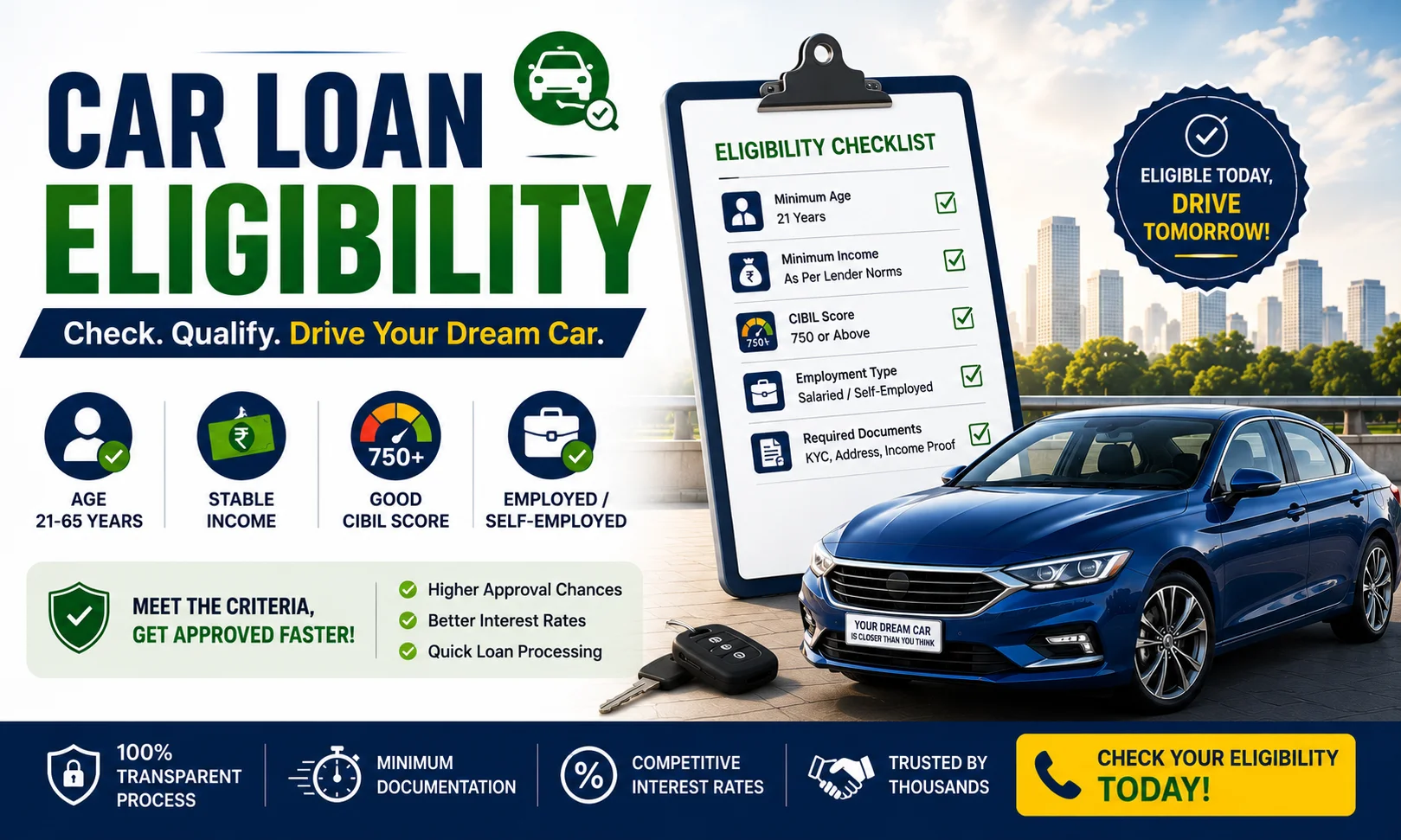
Buying a car through financing can make vehicle ownership more manageable, but lenders evaluate several factors before deciding whether an applicant qualifies for a car loan. Car loan eligibility generally depends on income, age, employment or business stability, credit history, existing financial obligations, repayment capacity, vehicle details, and lender-specific policies.
If you are planning to buy a new or used car, understanding the eligibility requirements before applying can help you choose a realistic vehicle budget, prepare the right documents, and avoid unnecessary loan applications.
Looking for a car loan? Check your eligibility with Apni Car India and explore suitable financing options based on your profile.
What Is Car Loan Eligibility?
Car loan eligibility refers to the criteria a bank, NBFC, or other financing institution uses to determine whether an applicant is suitable for vehicle financing and how much they may potentially be able to borrow.
Lenders generally evaluate your financial profile rather than considering only one factor, which means a strong income may not automatically guarantee approval if there are significant existing liabilities, poor repayment history, insufficient documentation, or other risk factors.
Your eligibility can also vary between lenders because every financial institution may have different age limits, income requirements, credit policies, documentation standards, vehicle criteria, and methods for assessing repayment capacity.
Car Loan Eligibility Criteria in India
Although specific requirements differ between lenders, most car-loan applications are assessed using several common factors, including the applicant's age, income, employment or business profile, credit history, existing obligations, and proposed vehicle.
For example, current eligibility criteria published by major lenders demonstrate that salaried and self-employed applicants can have different income, age, employment, business-vintage, and documentation requirements.
| Eligibility Factor | What Lenders Generally Consider |
|---|---|
| Age | Applicant's age and age at loan maturity |
| Income | Monthly or annual income and repayment capacity |
| Employment | Job stability and employment history |
| Business Profile | Business vintage, income, and financial performance |
| CIBIL Score | Credit history and repayment behaviour |
| Existing EMIs | Current loans and monthly repayment obligations |
| Banking History | Bank transactions and income credits |
| Loan Amount | Requested amount compared with repayment capacity |
| Vehicle | New or used vehicle, model, price, and valuation |
| Documents | KYC, income, banking, employment, and vehicle documents |
What Is the Minimum CIBIL Score Required for a Car Loan?
There is no universal minimum CIBIL score that guarantees car-loan eligibility across every lender because financing institutions use different credit policies and assess the applicant's complete financial profile.
A higher CIBIL score generally indicates stronger credit behaviour, while a lower score can make approval more difficult or influence the financing terms offered by certain lenders. Current lender information illustrates that some institutions prefer scores around 700–750 or higher, while others state that there is no fixed minimum score.
Is 750 a Good CIBIL Score for a Car Loan?
A CIBIL score of 750 is generally considered a strong credit profile for borrowing, although the score alone does not guarantee approval because lenders can also evaluate income, employment stability, existing liabilities, repayment capacity, and other application details.
Applicants with strong credit histories may have better chances of accessing competitive financing, whereas borrowers with weaker credit profiles may need to provide stronger supporting information or explore lenders with suitable eligibility policies.
If your credit score is lower, you can read our detailed guide on car loan for low CIBIL score to understand the factors that may influence your financing options.
Car Loan Eligibility Based on Income
Income is one of the most important factors because lenders need to determine whether your regular cash flow is sufficient to support the proposed EMI without creating excessive financial pressure.
There is no single salary figure that guarantees car-loan eligibility because lenders can consider existing EMIs, credit profile, employment stability, requested loan amount, tenure, and overall repayment capacity alongside your income.
For example, an applicant earning ₹50,000 per month may have different borrowing capacity from another applicant earning the same amount if their existing loans, credit history, expenses, or requested vehicle price are significantly different.
How Salary Affects Car Loan Eligibility
Higher and stable income can generally provide greater repayment capacity, but lenders still evaluate how much of that income is already committed toward existing loans and other financial obligations.
If you already have substantial monthly EMIs, the amount available for a new car-loan repayment may be lower, which can affect the loan amount you may qualify for.
How Much Car Loan Can I Get Based on My Salary?
The amount of car loan you can potentially obtain depends on your monthly income, existing financial obligations, credit history, requested tenure, interest rate, vehicle value, and the lender's assessment methodology.
For this reason, it is not accurate to claim that a particular salary automatically qualifies someone for a fixed car-loan amount, because two applicants with identical salaries can receive different eligibility assessments.
Illustrative Example:
Suppose an applicant earns ₹60,000 per month and has no significant existing EMIs, while another applicant earns the same amount but already pays several monthly loan instalments.
The first applicant may have greater available repayment capacity than the second applicant, demonstrating why lenders evaluate existing obligations rather than considering salary in isolation.
Car Loan Eligibility for Salaried Individuals
Salaried applicants generally need to demonstrate stable employment and regular income through documents such as salary slips, Form 16, bank statements, and applicable identity and address proofs.
Current documentation requirements published by lenders commonly include recent salary slips, Form 16 or income-related documentation, bank statements, and KYC documents, although the exact requirements vary between financial institutions.
Factors Considered for Salaried Applicants:
- Monthly salary and net income
- Employment stability
- Employer profile
- Work experience
- CIBIL score
- Existing EMIs
- Bank account activity
- Requested loan amount
- Vehicle price
- Repayment capacity
A salaried applicant with stable employment, regular salary credits, manageable existing obligations, and a healthy credit history may present a stronger overall profile than an applicant with irregular income or significant outstanding liabilities.
Car Loan Eligibility for Self-Employed Individuals
Self-employed applicants can apply for car financing, but lenders may assess business stability, income consistency, business vintage, banking activity, tax returns, and financial statements before determining eligibility.
Depending on the lender and applicant structure, self-employed borrowers may be asked for ITRs, bank statements, business proof, financial statements, GST-related documents, or other evidence demonstrating income and business continuity.
Documents Commonly Requested From Self-Employed Applicants:
- PAN and applicable KYC documents
- Address proof
- Income Tax Returns
- Bank statements
- Business registration or existence proof
- GST documents, where applicable
- Profit and loss statements
- Balance sheets, where applicable
- Business-related financial records
The exact documentation depends on whether you operate as a proprietor, professional, partnership, company, or another business structure, so applicants should confirm the current requirements with the respective lender.
Car Loan Eligibility for First-Time Buyers
First-time car buyers can explore vehicle financing even if they have never previously taken a car loan, although lenders may assess their credit history, income, employment profile, banking activity, and repayment capacity before making a decision.
Having no previous loan history is different from having a poor credit history, because a new-to-credit applicant may simply have limited borrowing information rather than a record of missed or delayed payments.
If you are purchasing your first car, selecting a vehicle that fits comfortably within your income and repayment capacity can make the overall financing requirement more manageable.
Does Existing EMI Affect Car Loan Eligibility?
Yes, existing EMIs can affect car-loan eligibility because lenders consider your current financial commitments when evaluating how much additional monthly repayment you can reasonably manage.
Credit-information guidance also highlights that lenders consider the proportion of existing loan obligations relative to income when evaluating loan applications, making debt obligations an important part of the eligibility assessment.
For example, someone earning ₹70,000 monthly with minimal existing obligations may have substantially different repayment capacity from another applicant earning ₹70,000 while already paying several large EMIs.
Does CIBIL Score Affect Car Loan Eligibility?
Your CIBIL score can influence how lenders assess your creditworthiness because it reflects information about your credit history and repayment behaviour.
However, the score should not be viewed as the only deciding factor because lenders can also consider income, employment or business stability, existing liabilities, banking history, requested loan amount, vehicle details, and their internal credit policies.
Maintaining timely repayments, keeping credit utilisation under control, monitoring your credit report, and avoiding unnecessary borrowing can help maintain a healthier credit profile over time.
Does Down Payment Affect Car Loan Eligibility?
A down payment reduces the amount you need to finance, which can consequently reduce the EMI associated with the vehicle purchase and potentially make the overall borrowing requirement more manageable.
However, a larger down payment does not automatically guarantee loan approval because lenders continue to assess credit history, income, repayment capacity, documentation, vehicle details, and other applicable criteria.
If you are specifically looking for financing with minimal upfront contribution, you can explore our zero down payment car loan guide for more information about eligibility and financing considerations.
Car Loan Eligibility for New Cars
New-car financing is generally assessed based on the applicant's financial profile, requested loan amount, vehicle price, repayment capacity, credit history, and the lender's applicable policies.
If you are planning to purchase a new vehicle, you can explore Apni Car India's new car loan in Delhi page for more information about available financing assistance.
The amount you can borrow for a new car should ideally be evaluated alongside your down payment, EMI affordability, insurance, registration, maintenance, fuel expenses, and other ownership costs.
Car Loan Eligibility for Used Cars
Used-car loan eligibility can involve additional considerations because lenders may assess the vehicle's age, valuation, condition, documentation, and remaining useful life alongside the borrower's financial profile.
Documentation for used-car financing can include vehicle-related records such as the sale letter, valuation documentation, registration information, and other applicable papers, depending on the lender and transaction.
If you are planning to finance a pre-owned vehicle, explore our used car loan in Delhi page to understand the financing process and relevant considerations.
Car Loan Eligibility vs Loan Approval
Meeting basic car-loan eligibility criteria does not mean that your loan application will automatically be approved because the lender can conduct a more detailed assessment after receiving your application and supporting documents.
The final decision can depend on credit history, income verification, existing liabilities, employment or business stability, vehicle information, documentation, internal policies, and the lender's assessment of repayment capacity.
This distinction is important because eligibility information should be used to understand whether you may qualify, rather than being interpreted as a guaranteed promise of loan approval.
Documents Required for Car Loan Eligibility
The exact document checklist varies between lenders and applicant categories, but most car-loan applications require basic KYC information along with income, banking, employment or business, and vehicle-related documents.
TransUnion CIBIL notes that commonly requested auto-loan documentation can include identity proof, address proof, salary or income information, bank statements, and vehicle registration-related documents, while individual lenders may request additional paperwork.
Documents for Salaried Applicants
Salaried applicants may commonly need identity and address proof, recent salary slips, Form 16 or other income documentation, bank statements, photographs, and employment-related information.
Documents for Self-Employed Applicants
Self-employed applicants may commonly need identity and address proof, ITRs, bank statements, business-existence documents, financial statements, GST or other registration documents, depending on their business structure.
Documents for Used Car Loans
Used-car financing may additionally involve the vehicle's registration documents, sale letter, valuation report, insurance information, and other papers requested by the lender for verifying the proposed vehicle.
Car Loan Eligibility Documents Checklist
Before applying for a car loan, preparing your documents in advance can make the application process more organized and help you respond quickly if the lender requests additional information.
| Applicant Type | Common Documents |
|---|---|
| Salaried | KYC, salary slips, Form 16, bank statements |
| Self-employed | KYC, ITRs, bank statements, business proof |
| Business owners | Business documents, financial statements, ITRs |
| Used-car buyer | Vehicle RC, valuation, sale documents, insurance |
| Joint applicant | KYC and applicable income documents |
These documents are indicative rather than universal because each lender can request different documents depending on the applicant profile, loan product, vehicle, and verification requirements.
Can I Get a Car Loan Without CIBIL History?
Applicants without an established credit history may still explore car financing, although the lender may have less historical borrowing information available when assessing their credit profile.
Such applicants may need to demonstrate repayment capacity through stable income, employment or business continuity, banking history, appropriate documentation, and other financial information requested during the application process.
If you have never borrowed before, avoid assuming that the absence of a CIBIL history is equivalent to having a poor CIBIL score because these represent different credit situations.
Can I Get a Car Loan With a Low CIBIL Score?
A low CIBIL score can make car financing more challenging, but it does not necessarily mean that every lender will automatically reject the application because credit policies and assessment methods differ.
Lenders may consider other factors such as income, existing liabilities, repayment history, vehicle value, down payment, business stability, and the overall strength of the applicant's financial profile.
For a detailed explanation, visit our dedicated car loan for low CIBIL score page and understand the potential options available to borrowers with weaker credit profiles.
How to Improve Your Car Loan Eligibility
Improving your overall financial profile before applying can potentially strengthen your application, although no specific action can guarantee approval because the final decision remains with the respective lender.
1. Maintain Timely EMI Payments
Paying existing loan instalments on time helps maintain a healthy repayment history and can support a stronger credit profile over the long term.
2. Reduce Existing Debt
Reducing unnecessary outstanding debt can improve your available repayment capacity and may make your overall financial position more comfortable when applying for additional financing.
3. Maintain Stable Income
Consistent employment income or stable business earnings can help demonstrate that you have an ongoing source of funds to manage the proposed monthly repayment.
4. Keep Bank Statements Healthy
Maintaining organized banking records with regular income credits and responsible financial activity can make income verification easier during the lender's assessment process.
5. Avoid Unnecessary Loan Applications
Applying for multiple loans without understanding your eligibility can create additional credit enquiries, so it is better to research appropriate options before submitting applications.
6. Choose a Realistic Car Budget
Selecting a vehicle that comfortably fits your income and existing financial commitments can help keep the proposed loan amount and EMI within a more manageable range.
7. Consider a Higher Down Payment
A larger upfront contribution can reduce the amount you need to borrow, potentially lowering the resulting EMI and overall financing requirement.
Car Loan Eligibility and Interest Rate
Your eligibility and the interest rate offered are related but separate considerations because a borrower may qualify for financing while receiving terms that differ from another applicant.
Credit history, income, repayment capacity, loan amount, tenure, employment or business profile, vehicle details, and lender-specific pricing policies can all influence the final financing terms.
If you want to understand the current factors that can influence vehicle-financing rates, explore our detailed guide to car loan interest rates in Delhi.
Car Loan Eligibility Calculator
A car-loan eligibility calculator can help you estimate a suitable borrowing range by considering factors such as income, existing EMIs, interest rate, tenure, and proposed loan amount.
However, an online calculator should be treated as an estimate rather than a guaranteed loan offer because lenders use their own credit-assessment models, documentation, policies, and verification processes.
Information You Can Consider:
- Monthly income
- Existing monthly EMIs
- Expected interest rate
- Preferred loan tenure
- Proposed car price
- Down payment
- CIBIL score
- Employment or business profile
Using these details before visiting a lender can help you establish a more realistic budget and understand whether your expected EMI is compatible with your current financial commitments.
How to Calculate Car Loan Eligibility
Car-loan eligibility is generally influenced by repayment capacity rather than simply multiplying your monthly income by a fixed number because lenders consider multiple financial variables.
A simplified approach is to assess your income, subtract existing monthly obligations, determine an affordable EMI, and then estimate the loan amount that could correspond to that EMI under a particular interest rate and tenure.
For example, if your income is ₹60,000 and your existing EMIs already consume a significant portion of your monthly income, your available capacity for a new vehicle loan may be lower than someone earning the same amount without existing debt.
Because lender calculations differ, this approach should only be used for personal budgeting and not treated as a guaranteed eligibility formula.
What Factors Can Reduce Car Loan Eligibility?
Several factors can reduce your potential borrowing capacity or make the application more difficult, particularly when multiple risk factors occur together.
Low or Weak Credit History
A history of missed payments, defaults, settlements, or other negative credit events can influence how lenders assess your application.
High Existing EMIs
Large existing repayment obligations can reduce the amount of income available for a new car-loan EMI.
Irregular Income
Unstable employment or inconsistent business income can make it more difficult to demonstrate predictable repayment capacity.
Insufficient Documentation
Missing, outdated, or inconsistent documents can delay the assessment process or require additional verification before a lender can make a decision.
High Loan Requirement
Requesting a loan that appears disproportionate to your income, existing obligations, or vehicle value can affect the lender's assessment.
Older Used Vehicle
For used-car financing, vehicle age and condition can influence valuation, eligibility, loan tenure, and financing terms depending on lender policy.
How Apni Car India Helps With Car Loan Eligibility
Apni Car India helps customers understand vehicle-financing requirements and explore suitable car-loan options based on their individual financial profile, vehicle requirement, and applicable lender criteria.
Our assistance can include understanding your basic requirements, discussing financing possibilities, explaining documentation, and helping you navigate the application process without representing loan approval as guaranteed.
Whether you are purchasing a new car, used car, or exploring financing despite a weaker credit profile, understanding your eligibility before applying can help you make a more informed borrowing decision.
Why Check Your Car Loan Eligibility Before Applying?
Checking your eligibility before choosing a vehicle can help you establish a realistic purchase budget instead of selecting a car first and discovering later that the desired financing amount may not fit your financial profile.
It can also help you understand the documentation you need, identify potential credit-related issues, estimate your repayment capacity, and compare financing options more effectively before committing to a specific loan application.
Most importantly, eligibility assessment encourages you to consider the complete cost of vehicle ownership, including EMI, insurance, registration, maintenance, fuel, servicing, and other recurring expenses.
Car Loan Eligibility for Different Borrowers
| Borrower Profile | Important Eligibility Factors |
|---|---|
| Salaried Employee | Salary, employment stability, CIBIL, existing EMIs |
| Self-Employed Professional | ITR, business income, banking, CIBIL |
| Business Owner | Business vintage, financial statements, banking |
| First-Time Buyer | Income, credit history, repayment capacity |
| Low CIBIL Applicant | Overall financial profile and repayment history |
| Used Car Buyer | Vehicle age, valuation, condition, documentation |
| Joint Applicant | Combined eligibility and applicable lender criteria |
The importance of each factor can vary between lenders, so applicants should avoid treating a general eligibility table as a universal approval standard.
Step-by-Step Process to Check Car Loan Eligibility
Step 1: Check Your Credit Profile
Review your CIBIL score and credit report to identify outstanding accounts, repayment history, and any inaccuracies that could potentially affect your application.
Step 2: Calculate Existing EMIs
Add your current monthly loan obligations to understand how much of your income is already committed toward debt repayments.
Step 3: Determine Your Car Budget
Choose a vehicle price that fits comfortably within your income, savings, existing obligations, and expected ownership expenses.
Step 4: Estimate Your Down Payment
Determine how much you can contribute upfront without unnecessarily affecting your emergency funds or essential financial commitments.
Step 5: Estimate Your EMI
Calculate an estimated EMI using your expected loan amount, interest rate, and preferred tenure before proceeding with the purchase.
Step 6: Prepare Your Documents
Keep your KYC, income, employment or business, banking, and vehicle documents ready to make the application process more organized.
Step 7: Compare Financing Options
Compare applicable interest rates, processing fees, tenure, repayment conditions, foreclosure terms, and overall borrowing costs rather than selecting a lender solely based on one advertised feature.
Frequently Asked Questions About Car Loan Eligibility
What is car loan eligibility?
Car loan eligibility refers to the criteria lenders use to determine whether an applicant may qualify for vehicle financing and what loan amount or terms may potentially be suitable based on their financial profile.
What is the minimum CIBIL score required for a car loan?
There is no universal minimum CIBIL score applicable to every lender, although higher scores generally represent stronger credit profiles and some lenders publish preferred score thresholds for their products.
Is 750 a good CIBIL score for a car loan?
A CIBIL score of 750 is generally considered a strong credit profile, but it does not guarantee approval because lenders also evaluate income, existing liabilities, repayment capacity, employment, and other application factors.
Can I get a car loan with a low CIBIL score?
A low CIBIL score can make financing more challenging, but approval depends on the lender's policies and your overall financial profile rather than the score alone.
What salary is required for a car loan?
There is no single salary requirement applicable to every lender because eligibility can depend on income, existing EMIs, requested loan amount, credit score, employment stability, and repayment capacity.
Can self-employed people get a car loan?
Yes, self-employed applicants can apply for car financing, although lenders may request ITRs, bank statements, business documents, financial statements, and other evidence of income and business continuity.
Can a first-time buyer get a car loan?
Yes, first-time buyers can explore car financing, although lenders may assess their income, employment stability, credit history, banking activity, and repayment capacity before determining eligibility.
Does existing EMI affect car loan eligibility?
Yes, existing EMIs can affect eligibility because lenders consider current financial obligations when determining whether an applicant has sufficient repayment capacity for another loan.
Does a down payment improve car loan eligibility?
A higher down payment reduces the amount being financed and can consequently reduce the EMI, but it does not guarantee approval because lenders continue to evaluate the complete applicant and vehicle profile.
What documents are required for a car loan?
Common documents include KYC, identity and address proof, income documentation, bank statements, employment or business documents, and applicable vehicle-related papers.
Is car loan eligibility different for used cars?
Used-car financing can involve additional considerations such as vehicle age, valuation, condition, registration, insurance, and remaining useful life alongside the applicant's financial eligibility.
Can I get a car loan without a CIBIL history?
Applicants without an established credit history can explore financing, although lenders may rely more heavily on income, employment, banking history, documentation, and other indicators when evaluating the application.
Can I get a car loan without income proof?
Income verification is commonly part of car-loan assessment, although the documents accepted can differ depending on whether you are salaried, self-employed, or applying under another eligible borrower category.
How can I improve my car loan eligibility?
You can potentially strengthen your profile by maintaining timely repayments, reducing unnecessary debt, maintaining stable income, keeping accurate financial documents, avoiding unnecessary credit applications, and choosing an affordable vehicle.
Does a higher salary guarantee a higher car loan?
A higher salary can improve repayment capacity, but it does not guarantee a higher loan because existing EMIs, credit history, employment stability, vehicle price, requested amount, and lender policies can also influence eligibility.
Does car loan eligibility affect the interest rate?
Eligibility and interest rate are separate but related considerations, because lenders may use credit profile, income, repayment capacity, loan amount, tenure, and other factors when determining applicable financing terms.
Final Checklist Before Applying for a Car Loan
Before submitting your car-loan application, check your CIBIL profile, calculate your existing EMIs, determine a realistic vehicle budget, estimate the required down payment, and assess whether the expected EMI comfortably fits your monthly finances.
Keep your identity, address, income, employment or business, bank, and vehicle-related documents ready because lenders can request different documentation depending on your profile and the financing product.
Finally, compare the overall cost of borrowing rather than focusing only on the advertised interest rate, because processing charges, documentation costs, insurance requirements, prepayment conditions, and other applicable charges can influence the total cost.
Check Your Car Loan Eligibility With Apni Car India
Choosing the right car loan starts with understanding how much financing you can realistically manage rather than selecting a vehicle based only on its purchase price or advertised EMI.
Apni Car India can help you understand your financing requirements, explore applicable car-loan options, prepare relevant information, and navigate the application process based on your individual profile and vehicle requirements.
Whether you are a salaried professional, self-employed applicant, first-time car buyer, used-car buyer, or someone concerned about a lower CIBIL score, checking eligibility before applying can help you approach vehicle financing more confidently.
Talk to Apni Car India today to understand your potential car-loan eligibility and explore suitable financing options.
Get in Touch With Apni Car India

