
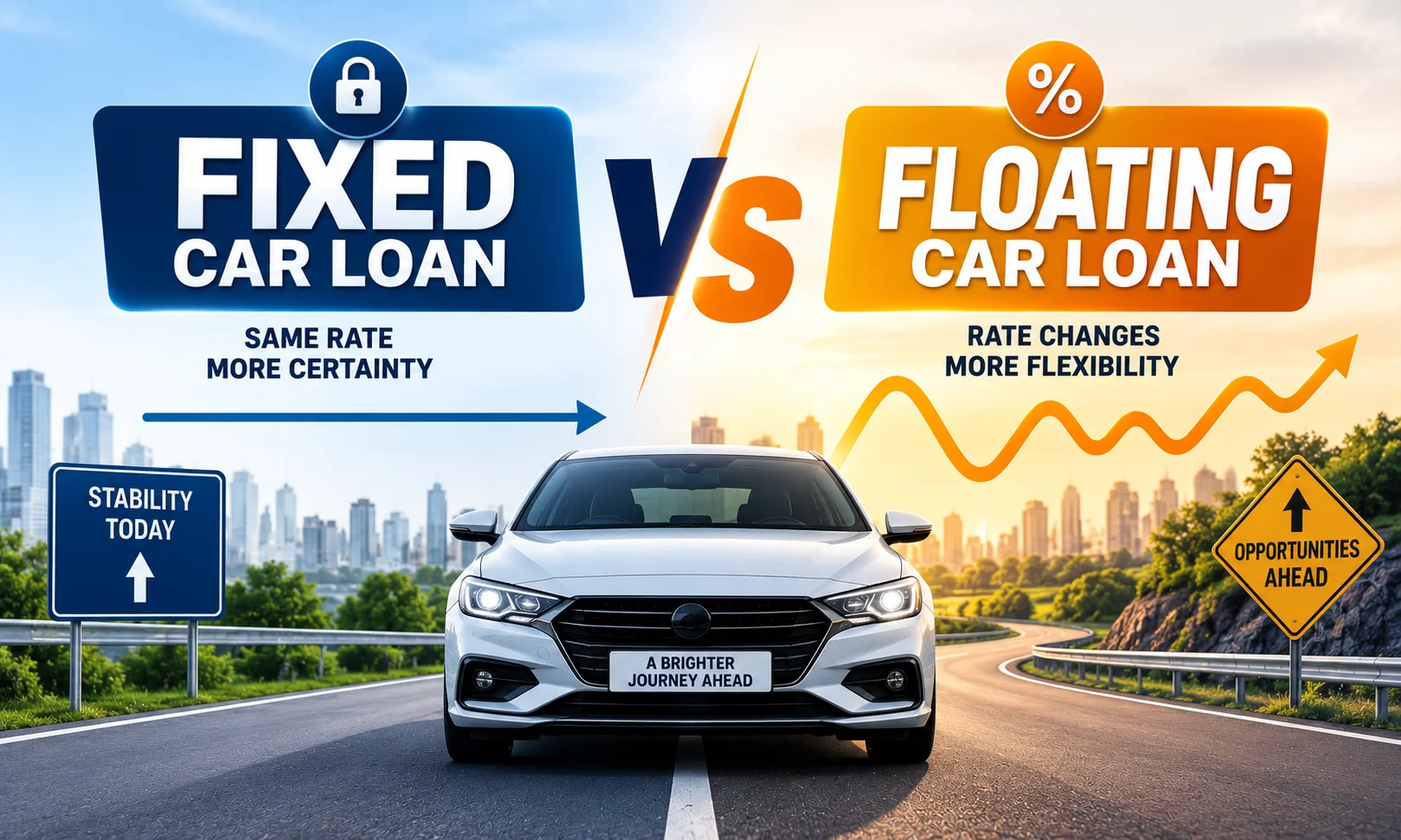
When choosing a car loan, the interest-rate structure can affect your EMI, total interest cost and financial planning throughout the repayment period. The two common structures are fixed and floating interest rates, but the better option depends on the starting rate, loan tenure, reset mechanism, fees and your ability to handle changes in borrowing costs.
For most borrowers, a fixed car loan offers greater EMI predictability, while a floating car loan provides potential benefits if the applicable benchmark-linked rate decreases but exposes the borrower to possible increases. There is no universally better option because lenders and loan products can use different rate structures and terms.
If you are still deciding how much you should borrow, first check your Car Loan Eligibility and then compare the applicable Car Loan Interest Rates in Delhi before selecting a loan structure.


Quick Answer: Fixed vs Floating Car Loan
A fixed-rate car loan keeps the applicable interest rate unchanged according to the terms of the loan agreement, making repayment easier to predict. A floating-rate car loan can change when its applicable benchmark or rate-reset mechanism changes, which means your EMI, loan tenure or total interest cost may change during repayment. The right choice depends on your financial situation rather than the rate type alone. If predictable EMIs and protection from rising rates are your priorities, a fixed structure may be more suitable. If you can tolerate rate changes and the floating rate offers a meaningful starting advantage, floating financing may be worth considering.What Is a Fixed-Rate Car Loan?
A fixed-rate car loan is a loan where the applicable interest rate remains fixed according to the terms agreed between the borrower and lender. Because the interest rate does not normally change during the applicable fixed period, the interest component used to calculate the EMI remains predictable. A fixed rate can make monthly budgeting easier because the borrower has greater certainty about the scheduled repayment. However, borrowers should not assume that every product described as “fixed” necessarily means the rate can never change under any circumstances. Some loan structures may provide a fixed rate for a specified period and then contain a reset or revision mechanism. Therefore, borrowers should carefully check the sanction letter, Key Facts Statement and loan agreement to understand exactly how long the rate remains fixed and whether any reset provisions apply. The Reserve Bank of India has specifically required key loan information to identify the interest type, applicable rate, reset date where relevant, fees and conversion charges, making these details important when comparing loan offers.Advantages of a Fixed Car Loan
The biggest advantage of a fixed-rate car loan is predictability. When the applicable rate remains fixed, you can plan your monthly car-loan payment without worrying about changes in market-linked interest rates affecting the scheduled repayment. A fixed rate can also be useful when your monthly budget is relatively tight. If your salary and household expenses leave limited room for unexpected increases in financial commitments, knowing the applicable loan rate in advance can make long-term budgeting easier. Fixed financing may also suit borrowers who do not want to speculate about future interest-rate movements. Instead of trying to predict whether benchmark rates will rise or fall, the borrower accepts the agreed rate in exchange for greater certainty.Disadvantages of a Fixed Car Loan
The main disadvantage is that a fixed-rate borrower generally does not benefit automatically when applicable market or benchmark rates decline. If new borrowers later receive lower rates, an existing fixed-rate borrower may continue paying the rate specified in the loan agreement. A fixed-rate loan may also have a higher starting rate than a floating alternative, depending on the lender and product. Therefore, comparing only the certainty of the EMI without checking the actual rate and total repayment can produce an incomplete assessment. Another important consideration is the meaning of “fixed” in the specific loan agreement. Some products can contain fixed-rate periods or other contractual provisions, so borrowers should verify the complete rate structure rather than relying only on the label used during the sales discussion.What Is a Floating-Rate Car Loan?
A floating-rate car loan has an interest rate that can change during the loan tenure according to the applicable benchmark, spread and reset mechanism specified by the lender. When the relevant benchmark changes, the lender may revise the applicable rate according to the terms governing the loan. Floating-rate loans therefore introduce an element of interest-rate uncertainty. If the applicable benchmark falls and the change is passed through under the loan terms, the borrower may benefit from a lower borrowing cost. If the benchmark rises, the borrower may face higher repayment costs. The exact mechanism should never be assumed to be identical across lenders. Depending on the product, a floating rate can be linked to an external benchmark or another reference rate, with the lender's spread or margin forming part of the final applicable rate.Advantages of a Floating Car Loan
The primary potential advantage of floating financing is that the borrower may benefit when the applicable benchmark-linked interest rate decreases. This can potentially reduce the interest burden compared with a fixed-rate alternative, depending on the starting rates and subsequent rate movements. Floating rates can also be attractive when the initial rate is meaningfully lower than the available fixed rate. However, the borrower should evaluate the difference over the entire expected repayment period rather than assuming that today's lower rate will remain lower throughout the loan. Another advantage is that some floating-rate structures may provide options around rate resets or conversion, subject to the applicable lender's policy and charges. RBI's framework for covered EMI-based floating-rate personal loans includes borrower options relating to EMI, tenure, switching to fixed rates and prepayment when specified reset events occur.Disadvantages of a Floating Car Loan
The main disadvantage of floating financing is uncertainty. If the applicable benchmark rises, your loan's interest rate can increase according to the reset mechanism, potentially affecting your EMI, repayment period or total borrowing cost. This uncertainty can make monthly financial planning more difficult for borrowers who have limited disposable income. A small increase may be manageable for one household but could create significant pressure for another household that already has rent, home-loan payments, education expenses or other EMIs. A floating rate also requires borrowers to understand the benchmark, spread, reset frequency and contractual provisions. Choosing a floating loan simply because its initial rate is lower can be risky if you have not checked how the rate can change later.Fixed vs Floating Car Loan: Key Differences
The fundamental difference is rate certainty versus rate flexibility. A fixed structure prioritises predictability, while a floating structure allows the applicable interest rate to move according to the terms of the loan and relevant benchmark. With a fixed loan, the borrower has greater certainty about the agreed interest rate during the fixed period. With a floating loan, the borrower accepts the possibility of both lower and higher rates over the repayment period. Neither structure should automatically be considered cheaper. The actual cost depends on the starting rate, future rate movements, loan amount, tenure, fees, prepayment terms and the specific conditions stated in the loan agreement.Fixed vs Floating Car Loan EMI Example
Consider an illustrative car loan of ₹8 lakh for five years. Suppose a borrower receives a fixed-rate offer at 9% per year and a floating-rate offer beginning at 8.5% per year. At 9% for five years, the illustrative EMI would be approximately ₹16,607 per month, assuming a standard reducing-balance EMI calculation. At 8.5%, the initial illustrative EMI would be approximately ₹16,411 per month if the floating rate remained unchanged. The initial difference is therefore only around ₹196 per month. This demonstrates why choosing a floating loan solely because its starting rate is slightly lower may not necessarily create a substantial financial advantage unless the rate remains favourable or falls further during the repayment period. If the floating rate later increases, the financial outcome can change. For example, if the applicable rate rises to 10%, the illustrative EMI on the remaining balance would be higher than it would have been at the original 8.5% rate. These figures are illustrative calculations and are not lender quotations. Actual EMI calculations depend on the sanctioned amount, applicable interest method, disbursement date, repayment schedule, fees and specific loan terms.What Happens If Floating Interest Rates Increase?
When the applicable floating interest rate increases, the lender may adjust the EMI, loan tenure or both according to the loan agreement and applicable regulatory framework. The exact effect therefore depends on the lender's repayment mechanism and the borrower's remaining principal and tenure. For covered floating-rate EMI-based personal loans, RBI's framework requires lenders to provide specified options when interest rates reset, including increasing EMI, extending tenure, combining both approaches, switching to a fixed rate under the lender's policy or making prepayments subject to applicable conditions. This means borrowers should not evaluate a floating loan only by looking at today's EMI. You should also understand what could happen to your repayment if the applicable interest rate rises during the loan tenure.What Happens If Floating Interest Rates Fall?
If the applicable benchmark and loan rate decrease, a floating-rate borrower may potentially benefit through a lower interest cost, depending on the lender's reset mechanism and how the rate change is passed through to the loan. The benefit may appear through a lower EMI, a shorter remaining tenure or a combination of repayment adjustments, depending on the lender's terms. Borrowers should therefore check exactly how rate reductions are reflected in their repayment schedule instead of assuming that every rate cut automatically reduces the EMI. The Department of Financial Services notes that new floating-rate personal and retail loans offered by banks, including auto loans, are subject to specified external benchmark frameworks where applicable. However, the exact benchmark and contractual structure should always be verified for the specific loan product.Does RBI Repo Rate Affect a Floating Car Loan?
A change in the RBI repo rate can affect floating-rate loans when the relevant loan product is linked to a benchmark that responds to the repo rate. However, borrowers should not assume that every car loan changes immediately or by exactly the same amount after an RBI policy decision. The final rate can depend on the benchmark, lender's spread or margin, reset frequency and other contractual terms. Therefore, the correct way to evaluate a floating car loan is to understand the benchmark and reset mechanism specified in the loan documentation. This distinction is important because a floating rate is not simply “the RBI repo rate.” It is generally determined through the benchmark and pricing structure applicable to the specific loan product.Does a Fixed Car Loan EMI Always Remain the Same?
A fixed-rate car loan generally provides stable repayment during the period for which the rate is contractually fixed, but borrowers should verify whether the agreement covers the entire tenure or only a specified period. The word “fixed” should therefore not be interpreted without reading the loan documents. Check the interest-rate clause, reset provisions, applicable fees and conditions governing any change in the rate before accepting the loan. RBI's Key Fact Statement framework requires lenders to disclose the interest type and, for relevant loans, the date of interest reset and other important charges. This makes the KFS an important document to review before accepting financing.Is a Floating Car Loan Always Cheaper?
No, a floating-rate car loan is not automatically cheaper than a fixed-rate car loan. A floating loan may begin at a lower rate, but future benchmark movements can increase the applicable rate and potentially raise the total borrowing cost. Similarly, a fixed loan can have a higher starting rate but provide protection against future increases. The correct comparison therefore requires evaluating the starting rates, loan tenure, expected rate sensitivity, fees and your ability to absorb potential changes. A borrower should compare the total cost and risk of each option, rather than choosing whichever loan has the lower advertised rate on the day of application.Fixed vs Floating Car Loan Based on Loan Tenure
Loan tenure plays an important role because it determines how long you remain exposed to the applicable interest-rate structure. A short three-year loan provides less time for rate movements to affect the overall cost than a seven-year loan. For a three-year loan, the difference between fixed and floating rates may be less significant if the initial rate difference is small and the borrower expects to repay quickly. However, the actual rates and charges should still be compared before making a decision. For a five-year loan, the borrower has a longer exposure period, making the future direction and reset mechanism of a floating rate more relevant. At this point, both potential savings and potential increases deserve consideration. For a seven-year loan, interest-rate changes can have a greater cumulative effect because the borrower remains exposed to the applicable rate for longer. Borrowers considering a longer tenure should therefore pay particular attention to the rate-reset mechanism and total repayment. You can also read Car Loan for Salaried Employees if your monthly salary and existing financial obligations are important factors in determining which repayment structure is appropriate.Which Is Better: Fixed or Floating Car Loan?
There is no universal answer because the better option depends on the difference between the available rates, your loan tenure, monthly budget, tolerance for uncertainty and the terms of the specific lender's product. A fixed-rate car loan may suit you better if you prioritise predictable EMIs, have limited flexibility in your monthly budget, want protection from rising rates or simply prefer certainty over potential savings. A floating-rate car loan may suit you better if you can comfortably handle potential rate changes, the initial floating rate is meaningfully lower, you understand the reset mechanism and you are comfortable accepting the possibility that the borrowing cost could increase. The most important principle is to choose the structure that matches your financial capacity rather than attempting to predict the direction of interest rates with certainty.Fixed vs Floating Car Loan for Salaried Employees
Salaried employees should consider their take-home income, existing EMIs, monthly household expenses and job stability when deciding between fixed and floating financing. A predictable EMI can be particularly useful when the monthly budget has limited room for unexpected increases. For employees with substantial disposable income and sufficient financial reserves, a floating structure may be easier to manage because a moderate increase in EMI may not significantly affect their household budget. However, this depends entirely on the individual financial profile. If you are a salaried employee planning to finance a vehicle, read Car Loan for Salaried Employees for information about salary, employment, CIBIL, existing EMIs, documentation and loan affordability.Fixed vs Floating Car Loan for First-Time Buyers
First-time car buyers should pay particular attention to repayment predictability because the car loan may be one of their first significant long-term financial commitments. Understanding the EMI, total repayment, interest structure and applicable charges is more important than simply selecting the lowest initial rate. A fixed-rate structure may appeal to first-time borrowers who prefer predictable payments, but it should not automatically be considered the better choice. A floating option can also be appropriate when the borrower understands the rate-reset mechanism and has sufficient financial flexibility. Read Car Loan for First-Time Buyers to understand eligibility, documents, down payment, EMI planning and common mistakes before applying.What Should You Check Before Choosing Fixed or Floating?
Before accepting a car loan, compare the complete loan structure rather than looking only at the advertised interest rate. The following information can materially affect the cost and flexibility of your borrowing.1. Applicable Interest Rate
Check the exact rate offered to you rather than relying on the lender's lowest advertised rate. Your final rate can depend on factors such as credit profile, income, loan amount, tenure, vehicle and lender relationship.2. Benchmark for Floating Loans
If the loan is floating, identify the benchmark against which the applicable rate is determined. Understanding the benchmark makes it easier to assess how future changes could affect the loan.3. Reset Frequency
Check how frequently the applicable rate can be reset and when the first reset can occur. This information helps you understand how quickly changes in the benchmark could potentially affect your repayment.4. Fixed-Rate Period
If the loan is described as fixed, confirm whether the rate remains fixed throughout the entire tenure or only for a specified period. Any future reset or revision provisions should be clearly understood before signing.5. EMI Adjustment Mechanism
Understand whether a rate change can alter your EMI, extend your tenure or affect both. This can make a significant difference to your monthly budget and total repayment.6. Processing and Other Fees
Interest is not the only borrowing cost. Check processing fees, documentation charges, stamp duty where applicable, insurance-related costs and any other charges included in the loan documentation.7. Prepayment and Foreclosure Conditions
Check whether partial prepayment or full foreclosure is allowed, when it can be exercised and what charges may apply. Current lender policies demonstrate that prepayment rules can differ based on borrower category and loan structure.8. Total Repayment Amount
Compare the total amount you are expected to repay rather than focusing only on the EMI. A lower monthly payment achieved through a longer tenure can result in greater total interest over the life of the loan.9. Key Fact Statement
Review the Key Fact Statement and loan agreement before accepting the financing. RBI's prescribed KFS format includes important information such as loan amount, tenure, interest type, interest rate, reset date, fees, foreclosure charges and conversion charges where applicable.Fixed vs Floating Car Loan: Common Mistakes to Avoid
Choosing Only the Lowest Starting Rate
The lowest starting rate does not automatically produce the lowest total borrowing cost. A floating rate that begins below a fixed rate can become more expensive if subsequent benchmark movements significantly increase the applicable rate.Assuming Fixed Means “Fixed Forever”
Always check the loan agreement to understand the duration of the fixed period and whether any reset or revision clause applies. The contractual terms matter more than how the product is described during the sales process.Ignoring the Reset Mechanism
Floating-rate borrowers should understand the benchmark, spread, reset frequency and method used to adjust EMI or tenure. Without this information, it is difficult to assess the potential effect of future rate movements.Looking Only at EMI
A lower EMI does not necessarily mean a cheaper loan. Increasing the tenure can reduce the monthly payment while increasing the number of months for which interest is charged.Ignoring Prepayment Conditions
If you expect to repay the loan early, compare applicable prepayment and foreclosure terms before selecting the lender. These charges can affect the actual benefit of choosing one loan structure over another.Assuming Every RBI Rate Cut Reduces Your EMI Immediately
The effect of a policy-rate change depends on the applicable benchmark and lender's reset mechanism. Borrowers should therefore examine the specific loan agreement rather than assuming that market-rate changes automatically produce an immediate EMI reduction.Fixed vs Floating Car Loan: Pros and Cons
A fixed-rate structure provides stronger repayment predictability and protection against increases during the applicable fixed period, making it easier for borrowers with strict monthly budgets to plan their finances. Its main disadvantage is that the borrower may not benefit from falling market-linked rates, and the starting fixed rate may be higher than a floating alternative depending on the lender and product. A floating-rate structure can provide potential savings when applicable rates decline and may start at a lower rate than a fixed alternative. However, the borrower accepts the possibility of higher rates and increased repayment costs in the future. The best decision therefore depends on whether you place greater value on repayment certainty or are comfortable accepting interest-rate risk in exchange for potential savings.Fixed vs Floating Car Loan: Final Verdict
Choose a fixed car loan when predictable repayment is more important to you than the possibility of benefiting from falling interest rates. This can be particularly relevant when your monthly budget is tight or you want greater certainty throughout the applicable fixed period. Choose a floating car loan when you can tolerate changes in EMI or tenure, understand the benchmark and reset mechanism, and believe the potential benefits justify accepting future interest-rate uncertainty. Before making the final decision, compare the actual fixed and floating rates available to you, calculate the EMI under different scenarios, check the total repayment, review all applicable fees and understand the lender's reset and prepayment provisions. For current lender rates and a broader comparison of car-loan pricing, visit Car Loan Interest Rate in Delhi.Frequently Asked Questions
What is the difference between a fixed and floating car loan?
A fixed car loan generally keeps the applicable interest rate unchanged during the agreed fixed period, providing greater repayment predictability. A floating car loan can change according to the applicable benchmark and reset mechanism, meaning the borrower's EMI, tenure or total interest cost can potentially change during the repayment period.Which is better, fixed or floating car loan?
Neither option is universally better. Fixed financing may suit borrowers who prioritise predictable EMIs and protection from rising rates, while floating financing may suit borrowers who can tolerate rate changes and want the possibility of benefiting when applicable benchmark-linked rates decline.Is a fixed car loan cheaper than a floating car loan?
Not necessarily. The cheaper option depends on the starting interest rates, subsequent rate movements, loan tenure, fees, prepayment conditions and other contractual terms. A floating loan can begin at a lower rate but become more expensive if the applicable rate increases substantially during repayment.Can a floating car-loan EMI increase?
Yes, a floating-rate car loan can become more expensive when the applicable interest rate increases. Depending on the lender's terms, the adjustment may result in a higher EMI, a longer repayment period or a combination of both.Can a floating car-loan EMI decrease?
Yes, a floating-rate loan can potentially become cheaper when the applicable benchmark-linked rate decreases and the reduction is passed through according to the lender's reset mechanism. The resulting benefit may appear through a lower EMI, shorter tenure or another repayment adjustment.Does the RBI repo rate directly determine every car-loan rate?
No. The repo rate can influence floating-rate loans where the applicable benchmark is linked to it, but the final borrowing rate depends on the specific benchmark, lender spread, reset mechanism and contractual terms. Therefore, borrowers should check the loan documentation rather than assuming a one-to-one relationship.Does a fixed car-loan EMI remain the same throughout the loan?
A fixed-rate loan generally provides stable repayment during the period covered by the fixed-rate agreement. However, borrowers should verify whether the rate is fixed for the entire tenure or only a specified period and whether the agreement contains any reset or revision provisions.Which is better for a five-year car loan?
There is no universal answer for a five-year car loan. Compare the actual fixed and floating rates, expected rate risk, reset mechanism, fees, prepayment terms and your monthly budget before choosing. The right option is the one whose cost and risk you can comfortably manage.Is floating interest better for a long-term car loan?
A floating rate can provide potential benefits over a longer period if applicable rates decline, but the borrower also remains exposed to future rate increases for longer. Longer-tenure borrowers should therefore pay particular attention to the reset mechanism and their ability to absorb higher repayments.Should first-time car buyers choose fixed interest?
First-time buyers may prefer fixed financing if predictable repayments are important to their budgeting, but fixed interest is not automatically better. A first-time buyer should compare the actual rates, total repayment, tenure and contractual conditions before choosing between fixed and floating financing.Can I switch from floating to fixed?
Switching may be possible for certain floating-rate loan products subject to the lender's policy, applicable charges and regulatory requirements. RBI's framework for covered EMI-based floating-rate personal loans provides for a fixed-rate switching option at reset subject to the lender's approved policy and applicable conditions.What should I check before signing a car loan?
Check the sanctioned loan amount, interest type, applicable rate, tenure, EMI, total repayment, benchmark if floating, reset frequency, processing fees, prepayment conditions, foreclosure charges and other applicable costs. Review the Key Fact Statement and loan agreement carefully before accepting the final financing terms.Important Information About Fixed and Floating Car Loans
Interest rates, lender policies, benchmarks, fees, repayment structures and eligibility requirements can change over time. The information in this article is intended for general financial education and should not be treated as a guarantee of any particular interest rate, EMI, loan amount or approval outcome. The actual terms offered to a borrower depend on the lender, loan product, credit profile, income, employment, vehicle, loan amount, tenure and other underwriting factors. Always verify the current rate, applicable charges and repayment conditions in the lender's Key Fact Statement, sanction letter and loan agreement before accepting financing. Last Updated: September 2026 Editorial Methodology: This article explains fixed and floating car-loan structures using publicly available lender information and RBI regulatory material. Examples are illustrative calculations designed to explain rate risk and should not be interpreted as lender quotations or predictions of future interest rates.Related Car Loan Resources
If you are comparing car-loan options, the following Apni Car India resources can help you evaluate different parts of the borrowing decision:- Car Loan Interest Rate in Delhi – Compare car-loan rates, factors affecting interest and lender considerations.
- Car Loan Eligibility – Understand income, CIBIL, age, documents and other eligibility factors.
- Car Loan for Salaried Employees – Learn how salary, employment and existing EMIs affect financing.
- Car Loan for First-Time Buyers – Understand first-car financing, down payment, EMI and application steps.
- How Much Car Loan Can I Get on ₹30,000, ₹40,000 & ₹50,000 Salary? – Explore illustrative salary-based loan calculations.
- New Car Loan in Delhi – Explore financing options for a new vehicle.
- Used Car Loan in Delhi – Understand financing considerations for pre-owned cars.
- Car Loan for Low CIBIL Score – Explore financing considerations when your credit score is low.
Need Help Choosing the Right Car Loan?
Choosing between fixed and floating interest is only one part of the car-financing decision. Your salary, CIBIL profile, existing EMIs, vehicle price, down payment, loan tenure and lender terms should all be considered before selecting the final loan structure. Apni Car India can help you understand your financing requirements and explore suitable car-loan options based on your borrower profile and vehicle requirements. Check Your Car Loan Eligibility Calculate Your EMI Talk to Apni Car India